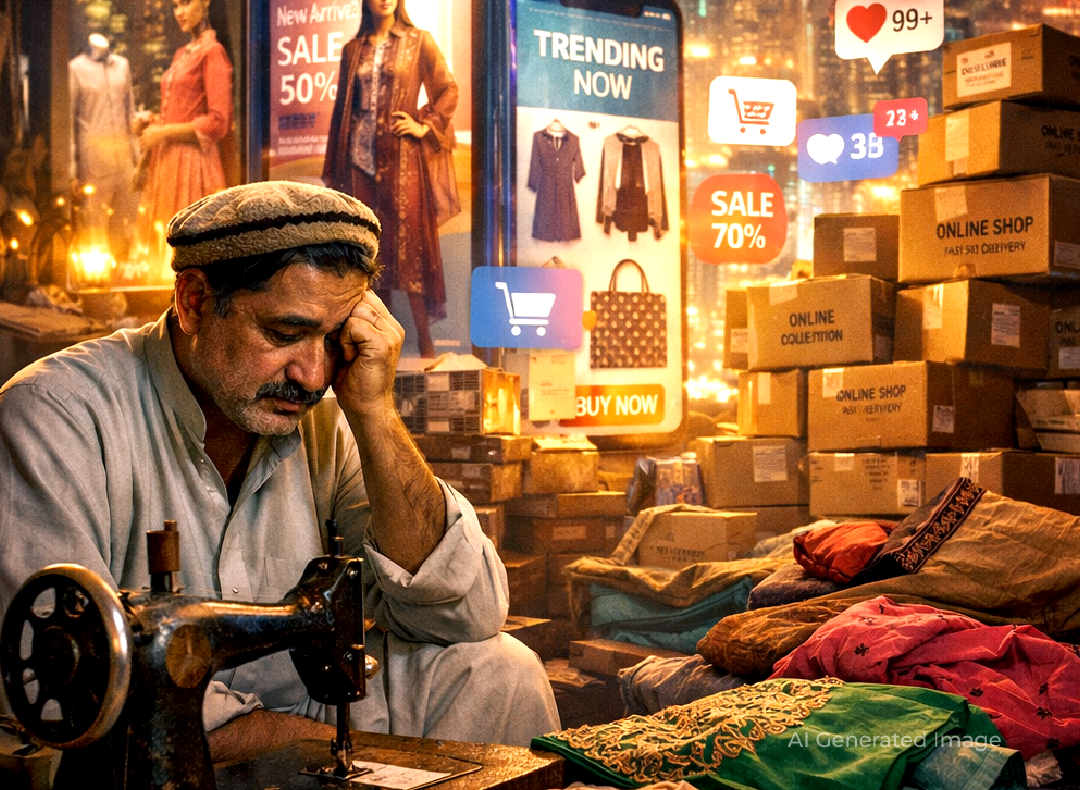


“I used to have so much work that I had to employ other women. But now, I mostly sit idle,” says 50-year-old Razia (name changed on her request), a home-based tailor from Lahore. Wife of a daily-wage laborer, with an irregular income, her home is run on a shoe string budget.
This winter season, her work stretched for only about ten days. She expects summers to be better and complains that, “Now people mostly bring simple stitching jobs. Earlier I have been stitching all types of fancy dresses like lehengas, shararas for weddings.”
The profession of tailoring in Pakistan, like so many others, is under a transition.
Economic Census 2023, conducted for the first time alongside the Population Census, found out that every fourth (28.4 percent) household of the country engages in one or the other home-based economic activity. Of these 10.9 million households, a whopping 51.35 percent, do animal farming.
Tailoring tops the list of activities other than animal farming with 3.85 percent of the households providing this service to fellow community members.
The census counted 419,533 households engaging in tailoring and 148,366 (1.36 percent) in embroidery as an economic activities.
The ‘household economic activity’ label here attempts to mask women’s work. It is common knowledge that a number of animal farming chores are performed by women and most of the other activities in this list like embroidery, producing eatables like samosa, muraba are exclusively women’s jobs. It will be safe to assume that all 419,533 households that engage in tailoring are actually women tailors, aka darzans like Razia. This is 1.09 percent of the total 38.3 million households of the country.
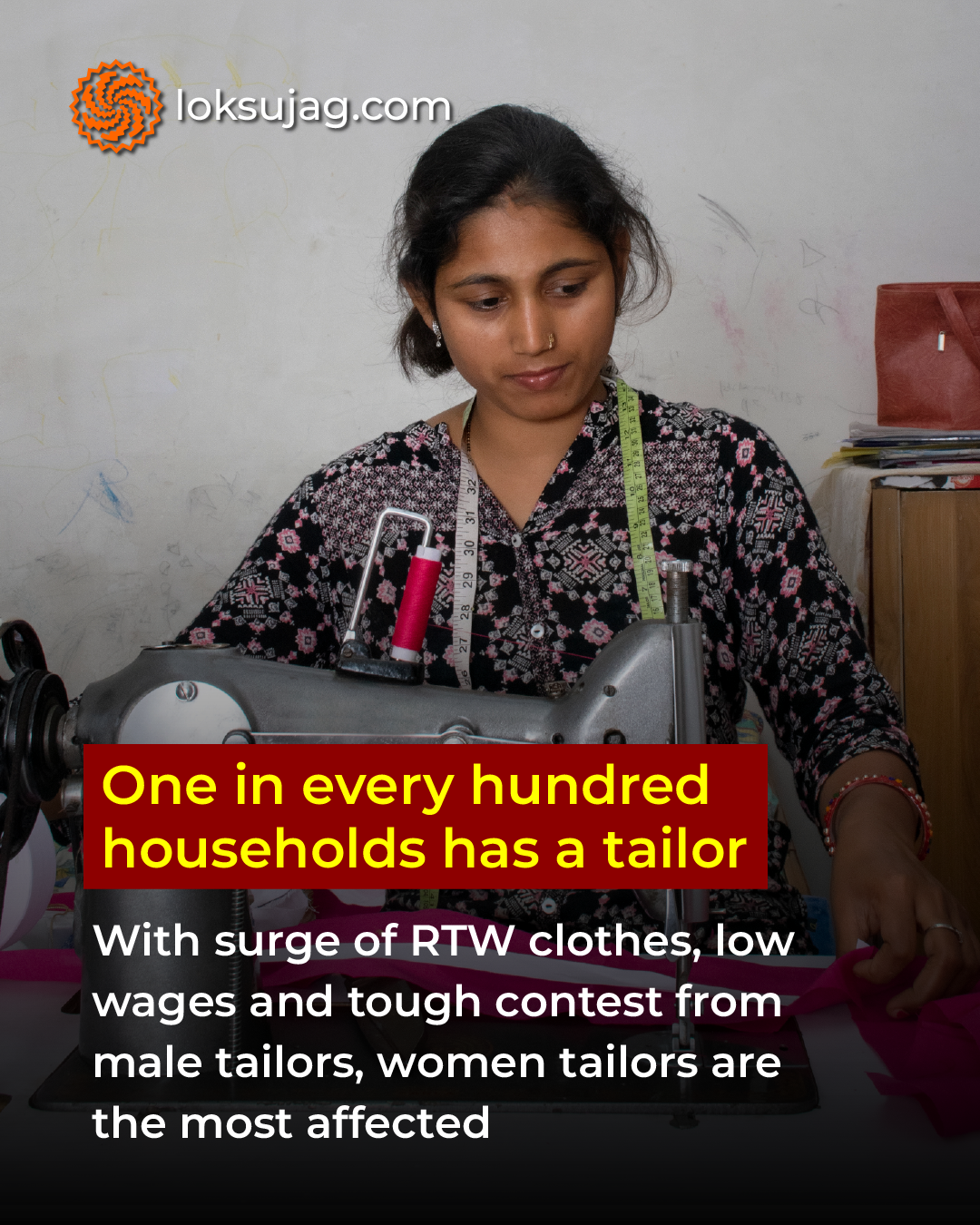
In other words, there is a darzan in every 100th household.
‘Ramzan is here and we are still waiting for customers’
Male tailors invariably operate from shops and they have been counted separately in the Economic Census 2023 under the category Shop Services which includes barber shops, tailoring shops and others. The census puts the total number of such shops at 825,254. If even half of them are assumed to be tailoring shops, the number of darzis and darzans (male and female tailors) in the country seem to be quite comparable.
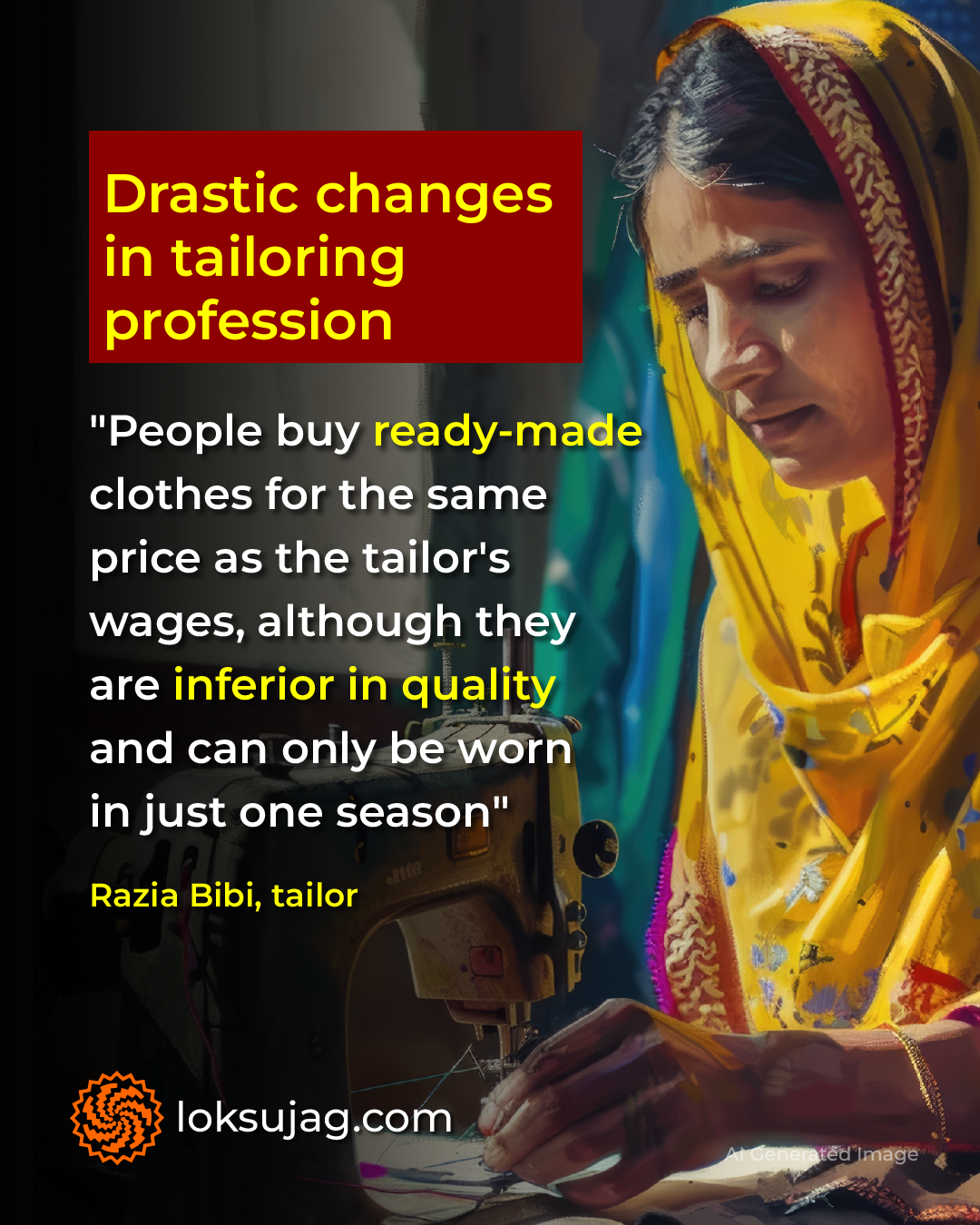
Razia believes that her business is down because people now prefer ready-made clothes. Most of the male tailors agree with her.
“Ramzan is here and we are still waiting for customers. This is not how it always was, we would be busy two months before Eid,” says Shabbir from Islamabad who has been working as a tailor for 25 years.
“People are getting ready-made clothes from shops at the cost of stitching charges, even though they are poor in quality and are usable only for one season,” he believes.
He explains that the fabrics that people buy from shops and stitching that tailors provide, both are better in quality and more durable than ready-to-wear (RTW) dresses, “but it is convenient to buy those and it has surely affected us,” he adds.
Hyderabad-based tailor, Sumi, has been working since 2009 and he claims, “Our work has been reduced to only 30 percent of what it used to be.”
Lok Sujag talked to tailors in Lahore, Islamabad, Hyderabad and Multan and most of them tell that they have been struggling in past five to 10 years.
How fast fashion is changing our clothing traditions?
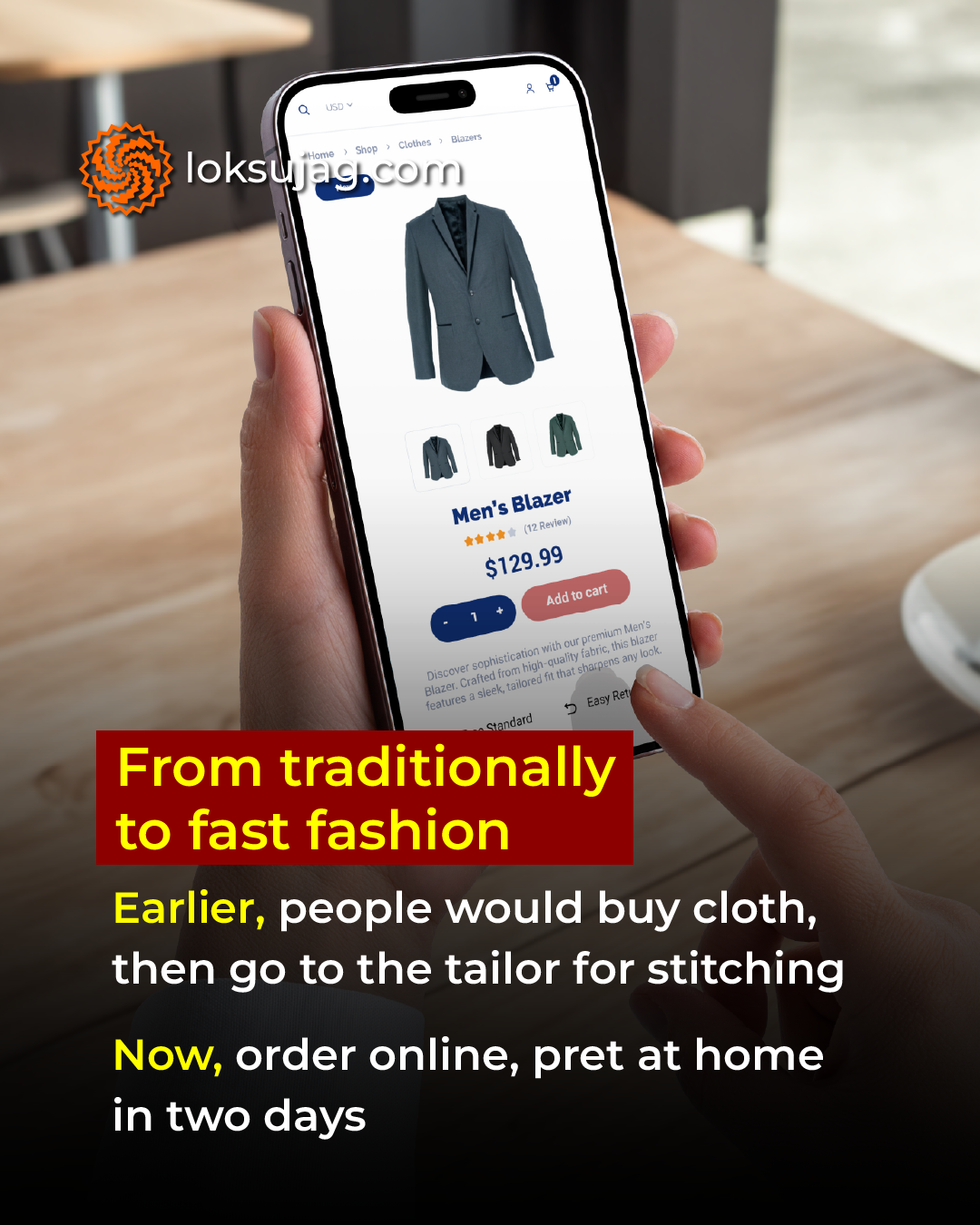
Buying unstitched fabric and getting it stitched by a neighborhood darzi or darzan has been a long standing tradition. Dresses didn’t fall in the fast-moving-consumer-goods category then as people used to get new dresses on Eid, a family wedding or on an occasion of similar social importance.
Durability of dresses was a major consideration, if not the top priority, in every purchase. Dresses were not discarded easily instead they would pass from one generation to the next and from older to younger siblings.
Our clothing traditions have changed drastically over past 25 or so years under the influence of what is called fast fashion.
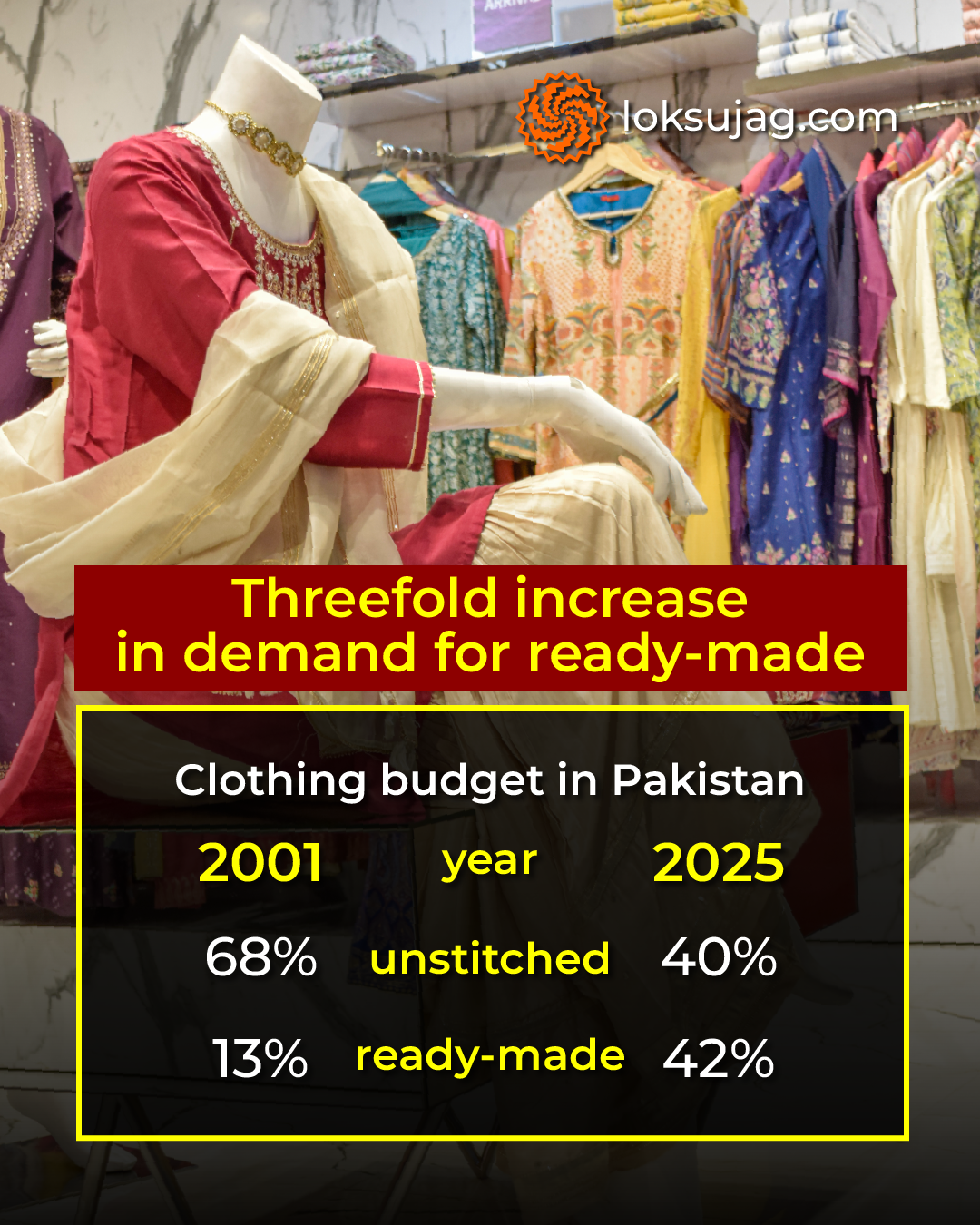
According to Household Integrated Economic Survey (HIES) 2001-02, Pakistanis had spent only 13 percent of their monthly clothing budget (consumption expenditure, in technical terms) on ready-to-wear dresses while 68 percent (two third) was spent on unstitched clothes and its accessories. RTWs also included second hand dresses as they too require no tailoring.
The same stats in the latest HIES 2024-25 reveal a different story. Now Pakistanis spend 42 percent of their monthly clothing budget on RTWs, which is three times more than what it was 25 years ago. This is also the first time that Pakistanis have spent more on RTWs than on unstitched clothes (42.08% on RTW, 39.52% on unstitched).
These figures are averaged for all the income groups from across the country which means they hide variations. HIES provides breakdowns of these stats for five quintiles of consumption expenditure (from poorest to richest) separately for urban and rural populations of all the four provinces.
The numbers in all these sets are obviously different from national averages but the shift from tailor-made to ready-to-wear is universal.
What has spurred growth of ready-to-wear market?
Data from successive HIE Surveys shows that share of RTWs had risen from 13 to 21 percent between 2001 and 2014 (50 percent increase) and in next 12 years, it doubled to 42 percent (100 percent increase). This increased speed of shift to RTWs in the last decade coincides with the rise of online shopping in the country.
There is no authentic data available about the size and composition of Pakistan’s e-commerce market. But most of the sources that offer some numbers agree that total value of the market now exceeds $10 billion and that it is growing at a fast pace of up to 20 percent per year. This is supported by the data from State Bank of Pakistan showing that value of e-commerce transactions through debit and credit cards has jumped from Rs 74 billion in 2019-20 to 434 billion in 2023-24. This is despite the fact that major mode of transaction in e-commerce (75 percent according to many) is cash-on-delivery.
All the information sources are also unanimous that clothes are among the top items purchased online. One market intelligence firm says that the highest number of online stores in Pakistan (27.82 percent of all; 17,380 in real numbers) sell clothes.
Many tailoring shops also now maintain online presence. They have websites and Facebook and Insta accounts and frequently use Whatsapp for communication with clients. Stitchhub.com and darazan.com say they can send riders to pick up unstitched cloth and a sample dress for size measurements from clients’ location while at sastadarzi.com clients can upload their measurements. Darzi Online went online about seven years ago and it has a sizable international clientele, overseas Pakistanis to be exact. The venture is an extension of a 35–40-year legacy of a family-run boutique and related services.
This demonstrates that tailors are trying to meet the challenges thrown upon them by new technologies but enterprises selling ready-to-wears online are clearly taking the cake.
So is tailoring a dying profession?
An intriguing aspect of HIES data is that average monthly expenditure on tailoring services has remained almost unchanged (in percentage terms) over past 25 years. It constituted 19.2 percent of the monthly budget of clothing in 2001-02 and stands at 18.4 percent now. That is a decline of less than one percent. On the other hand we see a major shift towards RTWs which require no tailoring and the two facts seem contradictory.
A majority of the tailors that Lok Sujag has contacted for this story complained of decline in their clientele but on average, two out of five also reported that they are managing just fine.
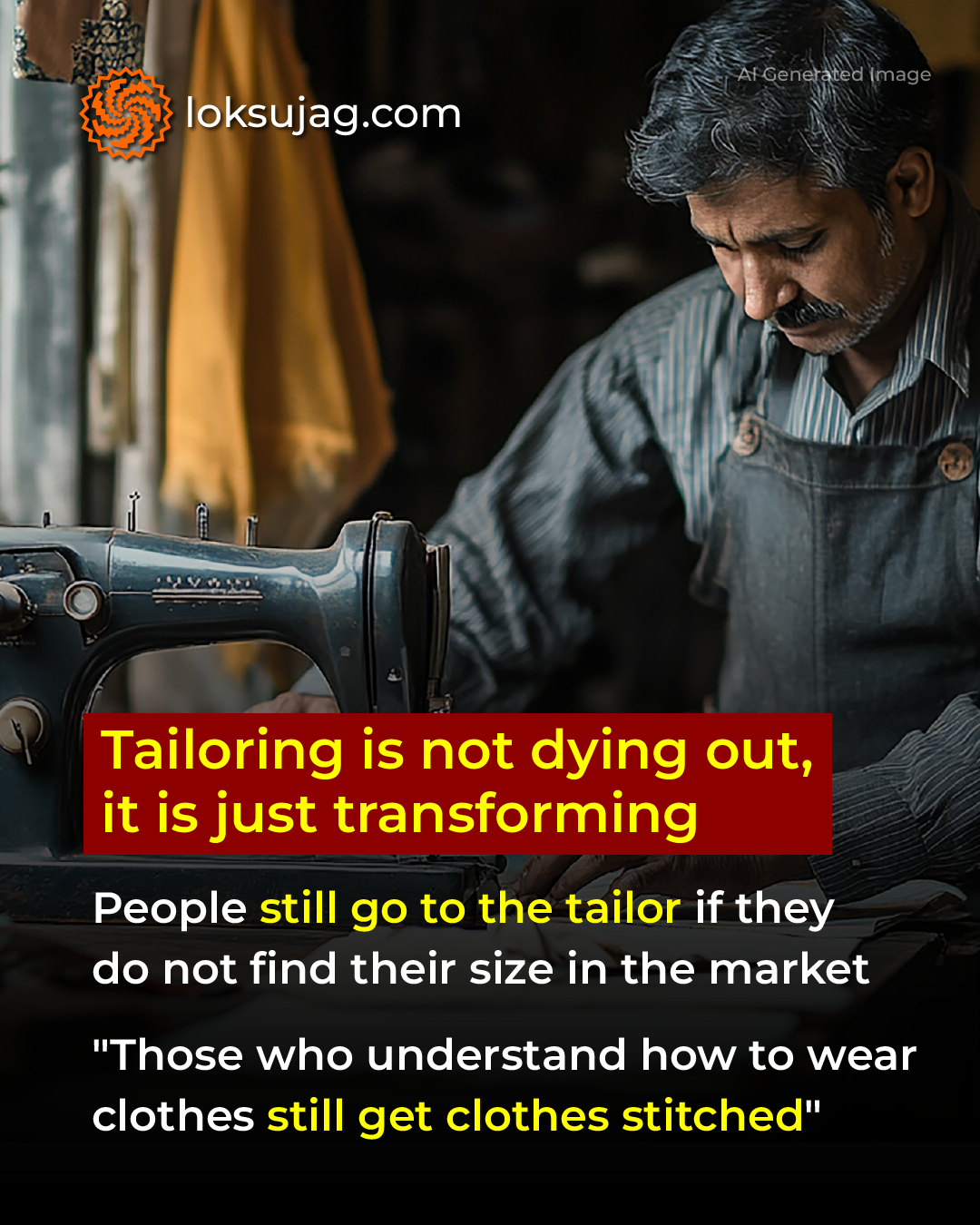
Some of them claimed that they are mainly operating on the orders from their old customers and or from the ones who cannot find their sizes in the market. But others had different views.
“Those who know what dressing up means still get their clothes stitched,” says Waheed from Islamabad who has been running his tailoring business for more than 30 years now. “There is a lot of difference between customised and ready-made clothes,” he adds.
A Lahore-based tailor working at a shop in DHA agrees. He maintains that tailors who are not good at their work have borne the brunt. “We have customers of all ages, both young and old. Ready-mades have not affected our business,” he claims.
So what’s actually going on?
Here is clue that may help solve this riddle.
Spending on unstitched clothes has undoubtedly declined but there is no corresponding fall in spending on tailoring and these two facts put together can mean only one - tailoring has become expensive.
In 2001-02, average per household monthly expenditure on unstitched clothes was Rs 288 while that on tailoring was a quarter of this amount (28.1 percent or Rs 81). 25 years later expenditure on unstitched stands at Rs 1,604 and tailoring service now costs nearly half of this amount; that is 46.6 percent or Rs 747.
The rise in RTWs has reduced number of tailoring jobs but the cost per job - tailoring charges - has substantially increased. Tailoring is becoming a niche service and this is in line with the trends in other countries. In advanced economies, bespoke suits are considered a luxury that only the super-rich can afford.
Home based darzans in double jeopardy
The spoils of this evolving niche market are, however, not being reaped equally by women and men tailors. Women tailors operating from homes face competition from both the ready-to-wears and male tailors running tailoring shops. They complain of being underpaid. (No surprise!)
Saima Zia has been working as a tailor-designer for more than 10 years now. She is a graduate and a mother of four university going boys. She started her tailoring business by investing small amounts in making dresses and selling them within her social circle.
“I had to work very hard because people don’t really buy much from home-based businesses. Slowly, I became just a seamstress. With all the hard work not paying off, my heart was broken in many places. I was underestimated. Even today, I have to struggle a lot just to appease customers,” she says.
Her customers haggle over service charges. “I charge only 1500 for a suit, and that also includes some light designing, but everyone wants the suit stitched for 800 or for not more than 1000,” she adds.
Some women tailors may charge as little as 650 rupees for simple dresses just to stay in the business.
Fatima Athar, whose family has explored many tailors over the years, believes that it is only the quality that justifies charges. “Anecdotally, some of the best clothes I have had come from female tailors, and some of the worst my sister ever got came from male tailors. It is the quality that matters. Looking at the final product, no one can tell the gender of the tailor,” she says.
Speaking with customers, many say the difference in the work of men and women tailors shows in finishing details such as seam strength, fabric control, and overall polish. Over-locking, shrinking fabric in advance, and precise pressing are repeatedly cited as services women tailors often cannot provide. Male tailors mostly have specialized machines for each of these jobs and working in small teams, different members specialize in different chores. Women tailors on the other hand work alone with one simple sewing machine. They may be equally skilled but lack resources.
“The quality of my stitching is good and the finishing is neat,” asserts Razia, whose customers also give her lawn suits worth Rs 25,000, but expect her to keep her charges lower than male tailors. “This is daily-wage work, it isn’t consistent. Things are not going well, especially because of inflation,” she says.
Saima, however, wants to continue her struggle to establish herself as a home-based tailor-designer, and is planning to develop a team.
Published on 5 Mar 2026