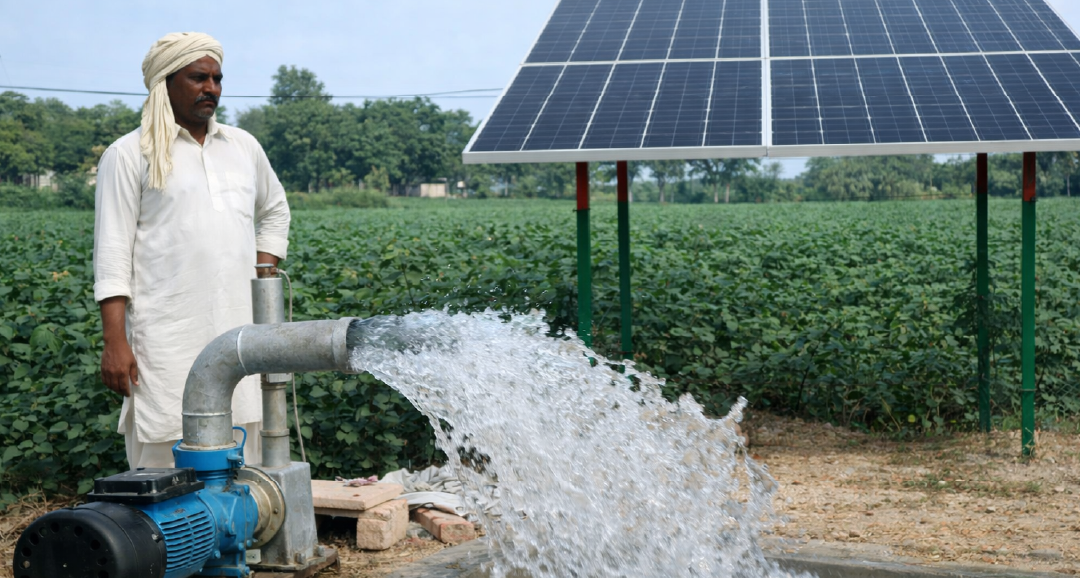


Free solar panels are being distributed among local households in Gilgit-Baltistan under a new energy project. Work on this project is being done at a rapid pace and the distribution is about to start.
This is election year in Gilgit-Baltistan. The list of candidates will be finalised on May 12 and then, after a four-week election campaign, votes will be cast in all 24 constituencies of the region on June 7. It seems that the free distribution of solar panels will begin at the very beginning of the election campaign or just before it.
It is inevitable to see the free distribution of solar panels by Prime Minister Shehbaz Sharif in the context of the election as the electricity crisis in the region is also an established fact.
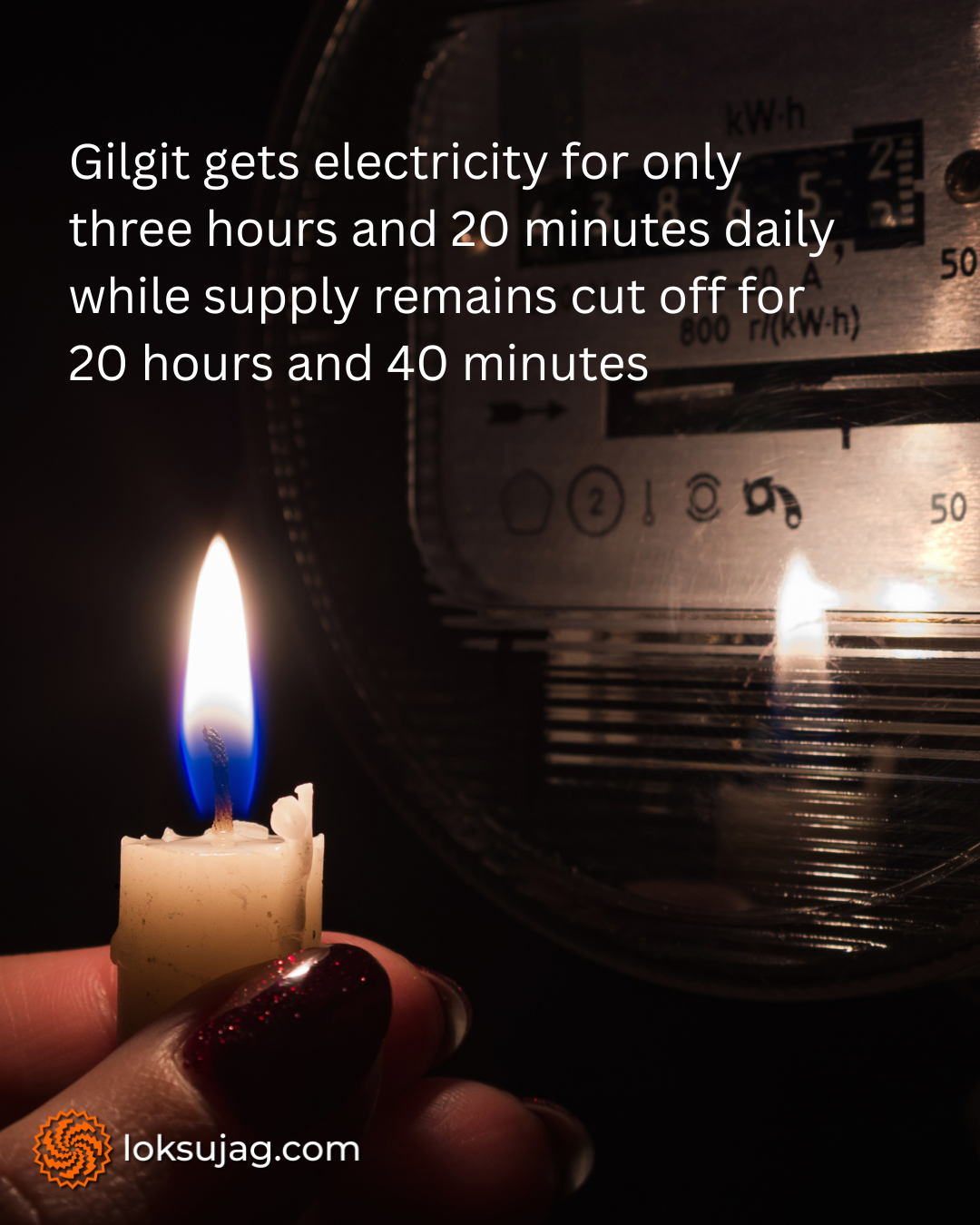
The Water and Power Department, Gilgit-Baltistan, announced last month that every neighborhood in Gilgit city will be provided with electricity for only three hours and 20 minutes daily, meaning that the supply will be cut off for 20 hours and 40 minutes out of 24 hours. If this is the situation in the capital, it is not difficult to imagine the situation in other cities and towns. Almost half the population in GB does not have access to electricity, due to which the total demand here is estimated at a maximum of 455MW. The region, which has a potential to generate about 60,000 MW of hydropower, is generating only 100MW. For one, the shortfall of 355MW, water shortage in winter and old hydro installations further reduce the production, making it difficult for people to live.
Javeria Bibi, a resident of Gilgit, is a social sciences student at the Karakoram International University. She says the university moved classes online immediately after the attack on Iran.
“Now, as soon as classes start, the internet goes down because the power supply to the phone towers is disrupted due to loadshedding. Every day, 60 to 70pc of my classes are lost to internet access. My studies are disturbed.”
The power crisis has not only affected daily life here, but it is also putting pressure on natural resources and increasing pollution in the region. The authorities have shown no interest in resolving the crisis for a long time, which has only made it worse.

Will solar energy project pay dividends?
Last year, the federal government approved the launch of 100MW solar projects in GB, which included the construction of 20 solar parks and installation of panels on government buildings. It would cost Rs24bn.
Now the government has also decided to upgrade the power transmission infrastructure here
for which an approval of another Rs9bn will be sought from the Executive Committee of the National Economic Council (Ecnec) this month. Thus, the total cost of these projects will be Rs33bn.
These projects were just entering the approval stages when the prime minister announced the distribution of 58MW solar panels in this region. Of these, 40MW have been allocated for domestic consumers and 18MW for shopkeepers and IT-related businesses.
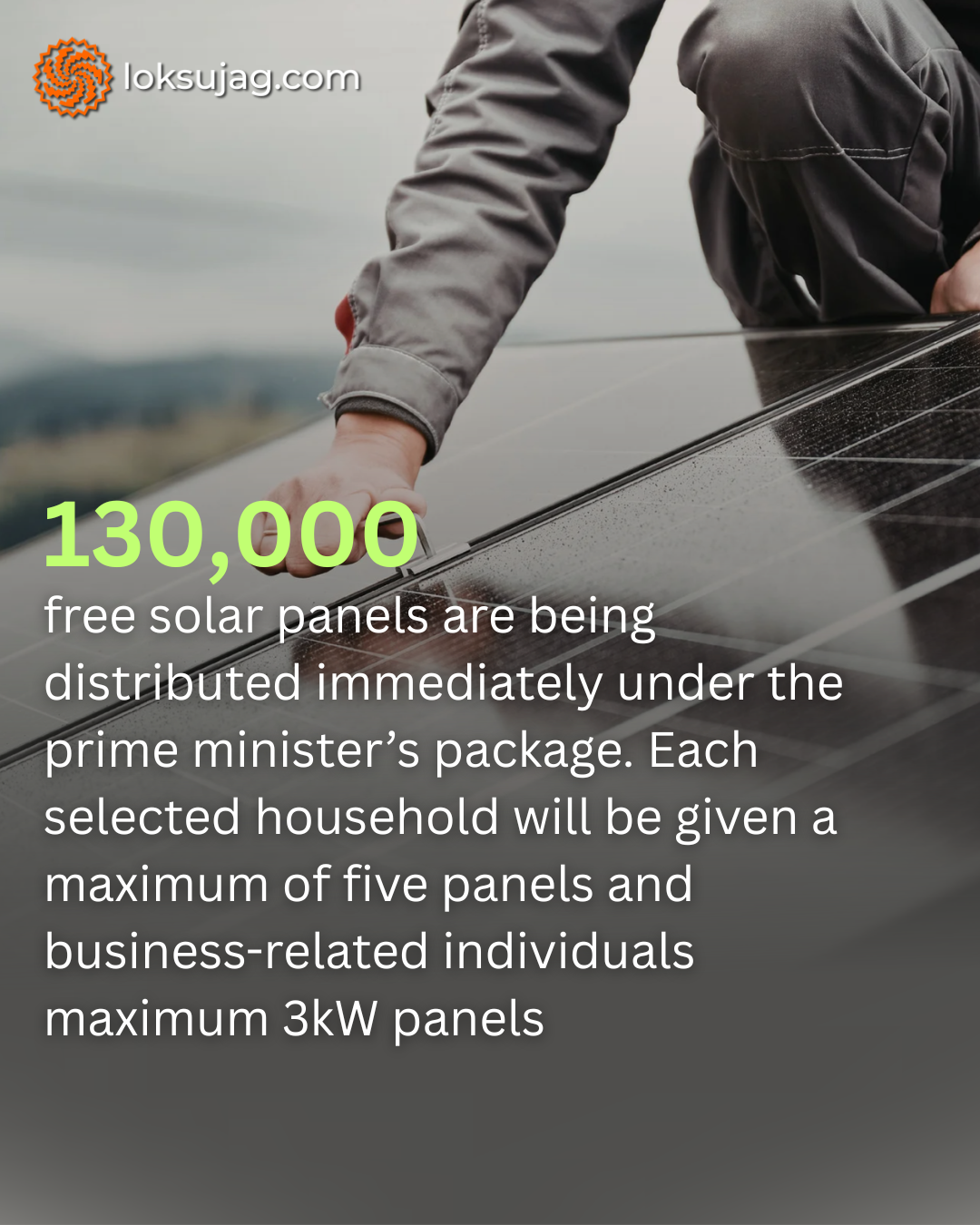
GB Secretary Power Safdar Khan says that a total of 130,000 solar panels are being distributed immediately and free of charge under the prime minister’s package. Applications were invited from all 10 districts of the province for which the only condition was to be a GB resident. The successful candidates were selected through a digital lottery last month. Local authorities are unaware of the quality and details of these panels or are unwilling to disclose them. However, the power secretary says that each selected household will be given a maximum of five panels and business-related individuals (or shopkeepers) a maximum of three kilowatt panels free of charge.
“The number of panels for a household will be determined by looking at its members and the nature of the business, which is being confirmed by government teams.”
Only solar panels, no inverters or batteries
The distribution of panels is expected to begin this week, but some experts are criticising the move. They say that the government is ‘spoiling’ good work to save some money, due to which the full benefit of the panels will not be taken.
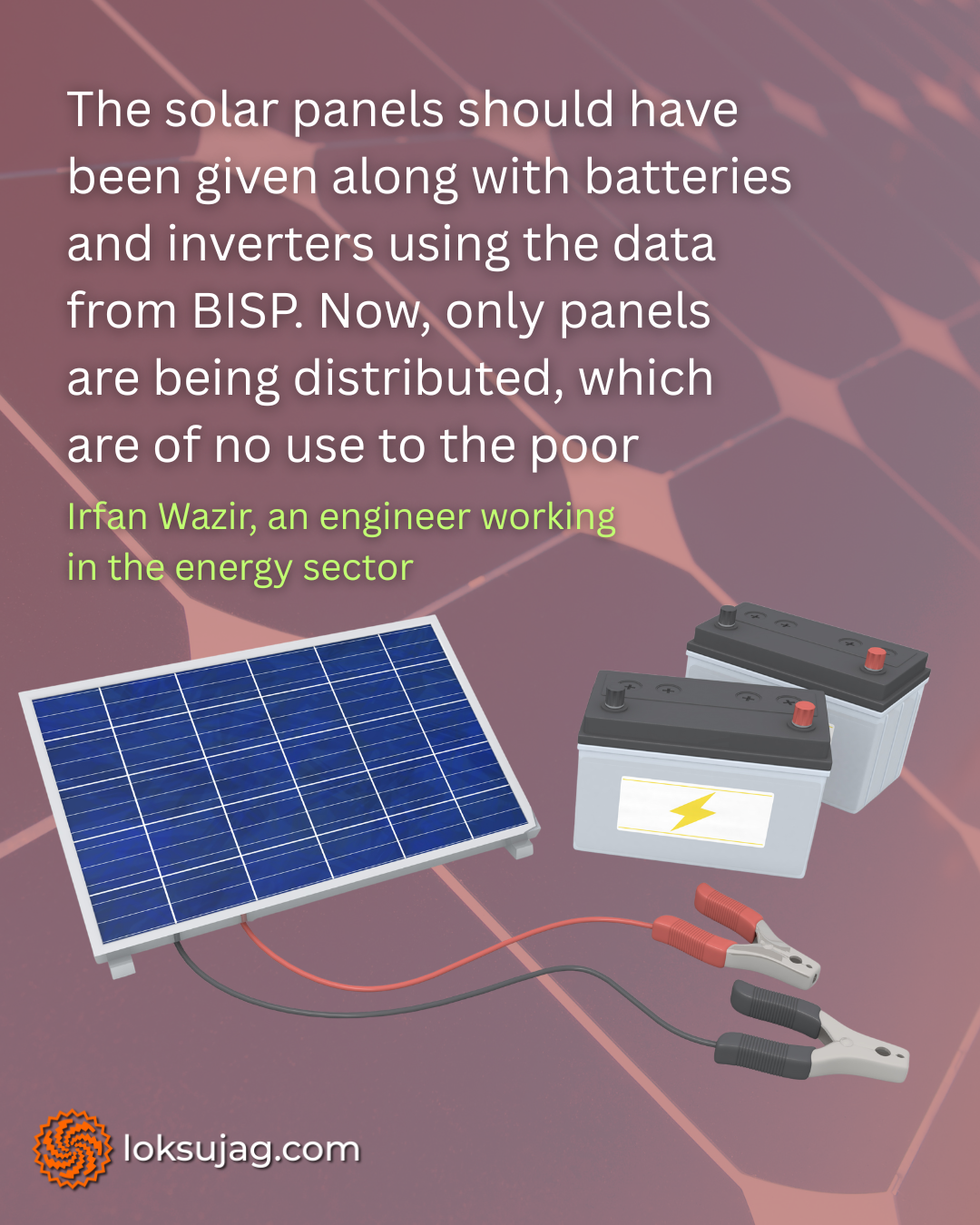
Irfan Wazir, an engineer working in the energy sector, says that it would have been understandable if the panels had been given along with batteries and inverters using the data from the Benazir Income Support Programme (BISP). Now, only panels are being distributed, which are of no use to the poor. Power Secretary Safdar Khan confirms that only solar panels have come in the prime minister's package, with which no installation kit, battery, controller or inverter will be provided.
An executive engineer (EXEN) of Wapda, on condition of anonymity, said that the said solar panels were confiscated at Karachi port and the government decided to distribute them in GB. Nothing is sure about their quality or any warranty.
“Even if they are right, how can we expect people who cannot afford to pay a modest electricity bill to spend hundreds of thousands of rupees on inverters and batteries and install panels on their homes?” He warned that if the government does not review the policy, these government solar panels will be seen being sold in the markets within a few days.
Caretaker Power Minister GB Mumtaz Hussain did not respond to this criticism. However, he stressed that these panels are the part of the prime minister’s relief package for the people, every stage of implementation of which is being completed in a transparent manner.
“GB—a graveyard of small and large power projects”
Regarding the pending solar projects, the power secretary says that out of 100MW, work orders for rooftop panels of about 12MW have been issued for government buildings, while work is underway on the remaining 6MW out of 18. He is hopeful that the remaining 82MW solar parks will be completed soon. If Rs9 billion for infrastructure is approved by Ecnec on time, this project too will be completed by December 2027.
“By the end of next year, we will meet the electricity needs of the area by combining solar power and hydropower,” says Power Secretary Safdar Khan
Engineer Irfan Wazir, who works in the energy sector, believes that the main problem of GB is the lack of a sustainable power policy. “The government is sometimes running after hydro and sometimes thermal generators or solar projects. It should first clear this confusion.”
Here, Naltar, Heinzel Power, Attabad, Ghowari Hydro Project and Diamer-Bhasha Dam have been pending for years, he says and adds that the entire region has become a graveyard of small and big projects.
Wazir says that five grid stations are being built in the region, but there is no electricity production. If the government continues like this, billions will be spent, but the electricity crisis will continue.
"Now, no study has been conducted for solar projects to see whether this area, which is prone to strong winds, rain, snowfall and flood risks, is suitable for rooftop panels or not."
The caretaker power minister Mumtaz Hussain does not believe these concerns are correct. He says that sunlight here is not only good but also very suitable for solar. Along with free panels, 18 MW rooftop panels are also being installed on government buildings, which will reduce the pressure on hydropower.
However, he admits that old power houses and transformers in GB have been undergoing repairs for several years, and some of them are not even getting spare parts.
“Now work is being done on the regional grid and infrastructure. This will help us distribute the 300MW of electricity generated by solar and the Diamer-Bhasha Dam.”
Questions about the appointment of project director
Officers of the Electricity Department are already expressing reservations over the proposed appointment of project director (PD) for federal solar projects.
An officer, speaking on condition of anonymity, said the advertisement suggests that the post of PD was advertised to reward a specific person. The government officials retire at the age of 60 but here the age limit has been set at 63, which Public Procurement Regulatory Authority (PPRA) also objected to.
“The candidate should have had experience in solar projects but it was not even mentioned in the advertisement.” However, despite the completion of the process, the project director could not be appointed.
The caretaker minister for electricity denies these allegations. He says that the maximum age limit for project directors is 63 years, neither is it being given to anyone. All legal requirements will be fulfilled for the appointment to this post.
Published on 6 May 2026