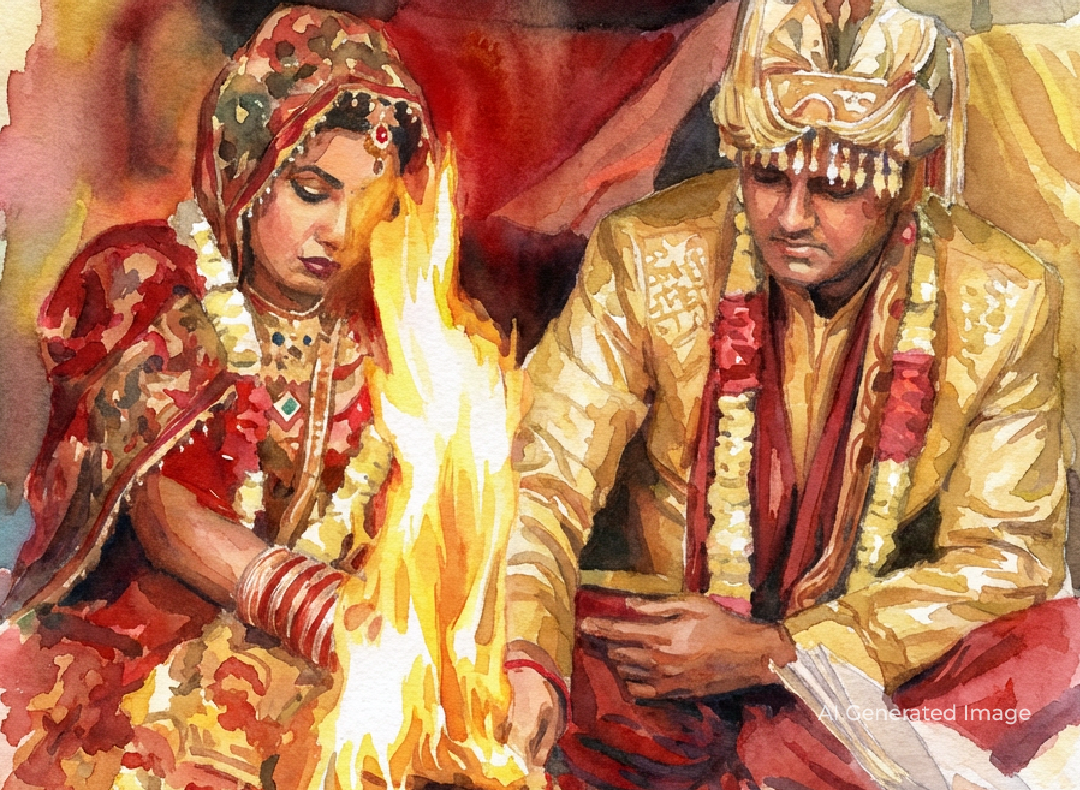


The law related to compulsory registration of marriage and resolution of family disputes in Pakistan was enacted in 1961 under the name of the Muslim Family Laws Ordinance. It was supposed to be legislated for all citizens of the country at once but here the largest minority, the Hindu community, was kept deprived of this legal right for decades.
Finally, the Parliament passed the Hindu Marriage Act in 2017, whose scope was kept limited to the federal capital of Islamabad, Punjab, Khyber Pakhtunkhwa and Balochistan but not in Sindh because a similar law already existed in the province.
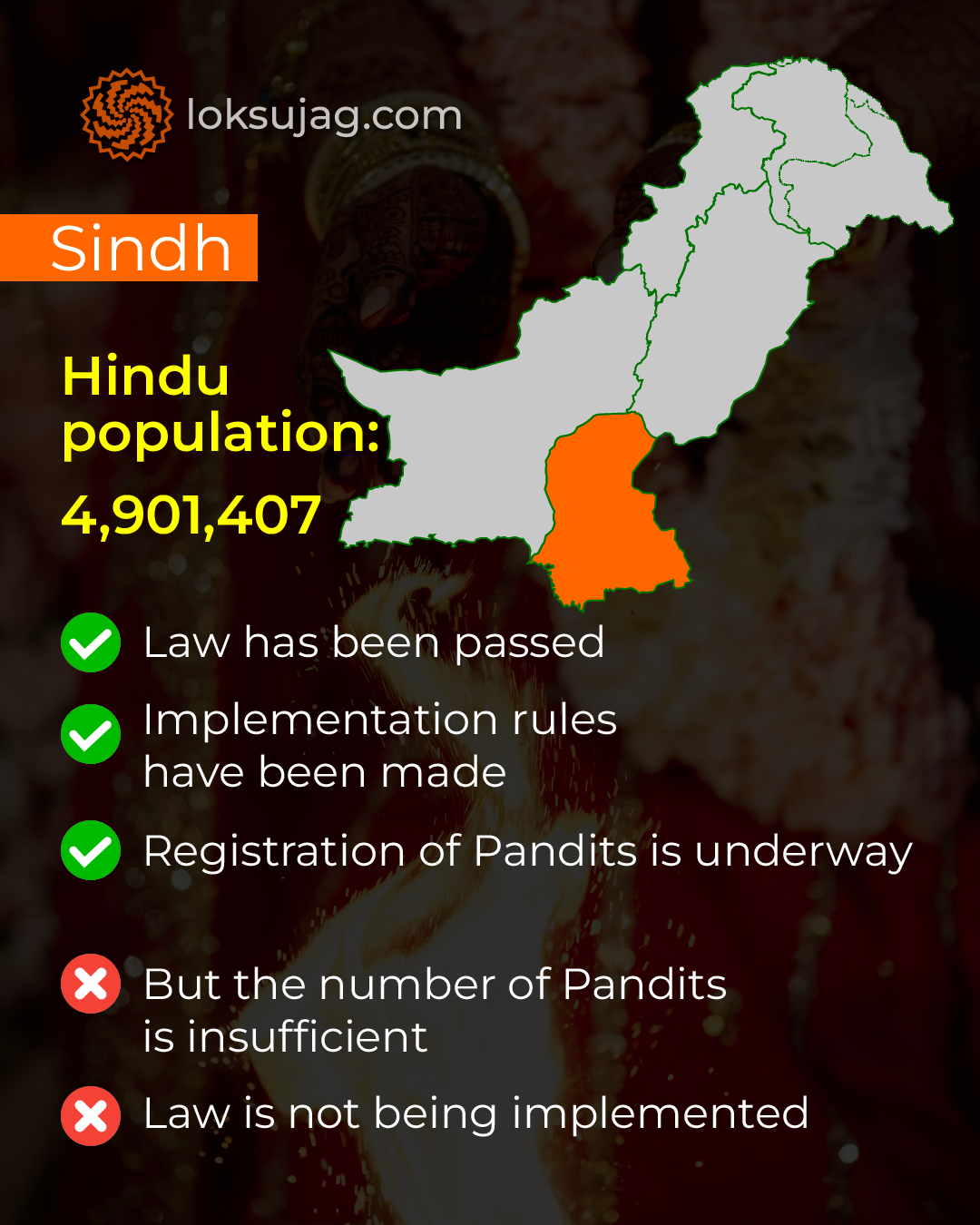
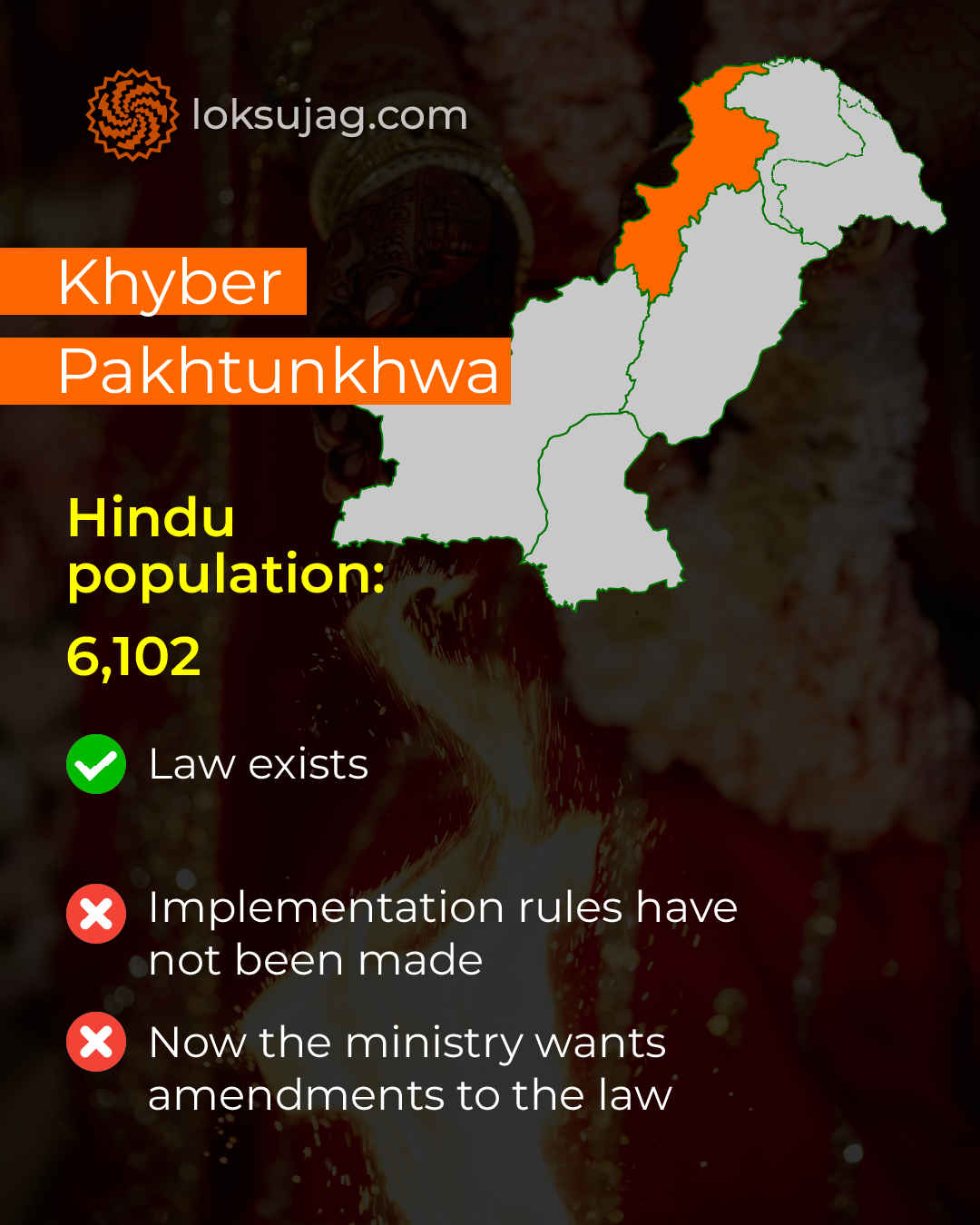
There, the provincial assembly approved the Sindh Hindu Marriage (Amendment) Act in 2018 and a year later, in 2019, its rules were made, leading to its implementation in the province. The Balochistan government adopted the Sindh rules in 2019 and announced implementation of the Hindu Marriage Act. After the Act was passed in Punjab and Islamabad, it took another seven years for the rules to be formulated there but its formal implementation started there last year. However, the Hindu community of Khyber Pakhtunkhwa is still waiting for the implementation of this law despite the passage of more than eight years.
Social activist Pushpa Kumari, a former member of the Sindh Human Rights Commission and a member of the National Lobbying Delegation (NLD) for Minorities, which played a key role in the passage of the Hindu Marriage Act, says that the majority of women in Hindu communities are illiterate and do not know either the law or their rights. That’s why Hindu women are constantly at the mercy of social injustice. Registration of marriages under this law will at least provide them with protection in case of domestic disputes.
“Unfortunately, the Hindu Marriage Act does not seem to be fully implemented in most parts of the country,” she says.
The law has been implemented but Pandit is missing
According to the Hindu Marriage Act 2017, marriage ceremonies can be performed according to the local traditions or customs of one party, for which the free consent of both the bride and groom and the presence of two adult witnesses are required.
The law includes a marriage form to be filled by the registrar (registered Pandit). The bride, groom and witnesses will sign this form, while the registrar, as an authorised officer, will record the signatures.
Under the law, marriage registration will be required within 15 days and it is the responsibility of the marriage registrar (registered Pandit), who will provide a copy of the marriage form to the parties concerned and ensure its entry in the official records.
The law states that the government will appoint a marriage registrar through an official gazette notification, which may be one or more for the convenience of the Hindu population living in a district or area. According to the procedure, after the registration of the marriage, a computerised marriage certificate or National Data Registration Authority (NADRA) form is issued by the union council (UC). This means that the role of the marriage registrar or Pandit in the Hindu marriage law is the same as that of the Nikah Khawan (Nikah registrar) in a Muslim marriage.
Tando Allahyar-based social worker Babulal Bheel says the Hindu marriage law was implemented first in Sindh, but in many areas, no Pandit had been registered yet. In some union councils, even if a Pandit goes for registration, the registration staff gets confused due to lack of awareness.
"As a result, in many Hindu-majority areas, marriages are not registered under this law."
Why are the Pandits not being registered?
The population of Union Council No. 14 of Hyderabad city is about 30,000, including 25,000 Muslims and more than 5,000 Hindus. There are 15 marriage halls registered here, meaning that there is one marriage registrar for about 1,500 Muslim population while not a single Pandit for all Hindu marriages.
UC Secretary Muhammad Zubair confirms that no one has approached him yet for Hindu marriage or Pandit registration.
Thirty-five-year-old Tilok Chand, a resident of village Donbaro in tehsil Chhachro of Tharparkar, is a Pandit from Meghwar, the largest Hindu community living here. His job is to conduct marriages and perform other religious rituals.
Chand says he came to know in October last year (2025) that the Hindu Marriage Act had come into force in the province, for which he (the Pandit) will now have to register.
“When I reached the UC office to register, the secretary was unaware of this law. I told him that Pandits are being registered in Umerkot, that is why I have come, but he refused to register me. After a month and a half, I was registered on the request of the UC chairman,” says Tilok Chand.
Awareness campaigns are conducted all over the world before the implementation of new laws and facilities are provided to the public for their implementation but nothing like this happened here.
Pandit Rana Ram, a resident of Rajar Colony in Mirpur Khas city, was the first person in this district to register himself as a marriage registrar. He said he had to pay Rs5,000 as a fee for his registration. The municipal officer clearly said if he wanted to register himself, he would have to pay this fee in any case.
It should be noted that the government fee for the registration of Muslim marriage priests in various union councils of the same district ranges from Rs800 to Rs1,000.
Every Pandit makes his own marriage certificate
Chandan Malahi, a member of National Lobbying Delegation (NLD) for Minority Rights, and coordinator of the National Human Rights Commission in Sindh, says that there are some obstacles in the full implementation of the law. Local bodies in Sindh are autonomous in setting their own fees and they have done that for Pandits and marriages in various UCs at their own pace.
He says the second major problem is that while there is a uniform form of marriage certificate for Muslim citizens across the country while the government has not prepared any such form or certificate for Hindu marriages. Every Pandit makes his own marriage certificate, which may lead to some problems.
“Last week, our delegation met with provincial additional secretary for local government, Aamir Hussain Panohar, in which the issues of uniform registration fees and uniform marriage certificate were put before him. He assured that both our problems would be resolved under the new rules. Officers will also be trained in this regard, for which the Hindu Marriage Act has already been included in the curriculum of the Local Government Academy,” says Malahi.
Krishan Sharma, chairman of the Pakistan Hindu Temple Management Committee, a federal body established to maintain temples, says that full implementation of the marriage law is very important. In this regard, he is not only in touch with the authorities, but all his colleagues are also running awareness campaigns in their respective communities. He seems very optimistic, but agrees that the pace of implementation of the Marriage Act is certainly slow, but the situation is constantly improving.
A minor mistake but eight years lapse
Krishan Sharma says the Hindu Marriage Act is applicable in all four provinces, but unfortunately, rules have not been made in Khyber Pakhtunkhwa yet. He, along with other colleagues, also met with provincial ministers and the speaker of the provincial assembly in Peshawar.
According to him, the proposed rules were previously a football match between different provincial ministries. Now it has been revealed that the Khyber Pakhtunkhwa law ministry has found a flaw in this act, for which it has proposed an amendment.
He says that in Sindh and Balochistan, the responsibility of registering Pandits and marriages has been given to the Local Government Department. The Khyber Pakhtunkhwa law ministry believes that the law has made the 'government' responsible for registration and the government means ‘cabinet’.
Therefore, the registration of marriages and Pandits should either be done by the provincial cabinet or the law should be amended to replace the word 'government' with 'local government'.
Haroon Sarab Diyal, a leader of the Hindu community and social activist in Khyber Pakhtunkhwa, says that dozens of cases are pending in the provincial courts, which cannot be decided due to the lack of rules for this law.
“This law was made to protect our daughters-in-law but due to the lack of rules, we are not able to register our marriages despite the passage of years. Therefore, it is necessary to approve the rules immediately in the province.”
Also read this

Inheriting inequality: The long struggle of a Hindu woman to inherit her ancestral property
Rahim Yar Khan: 200,000 Hindus but no marriage registration
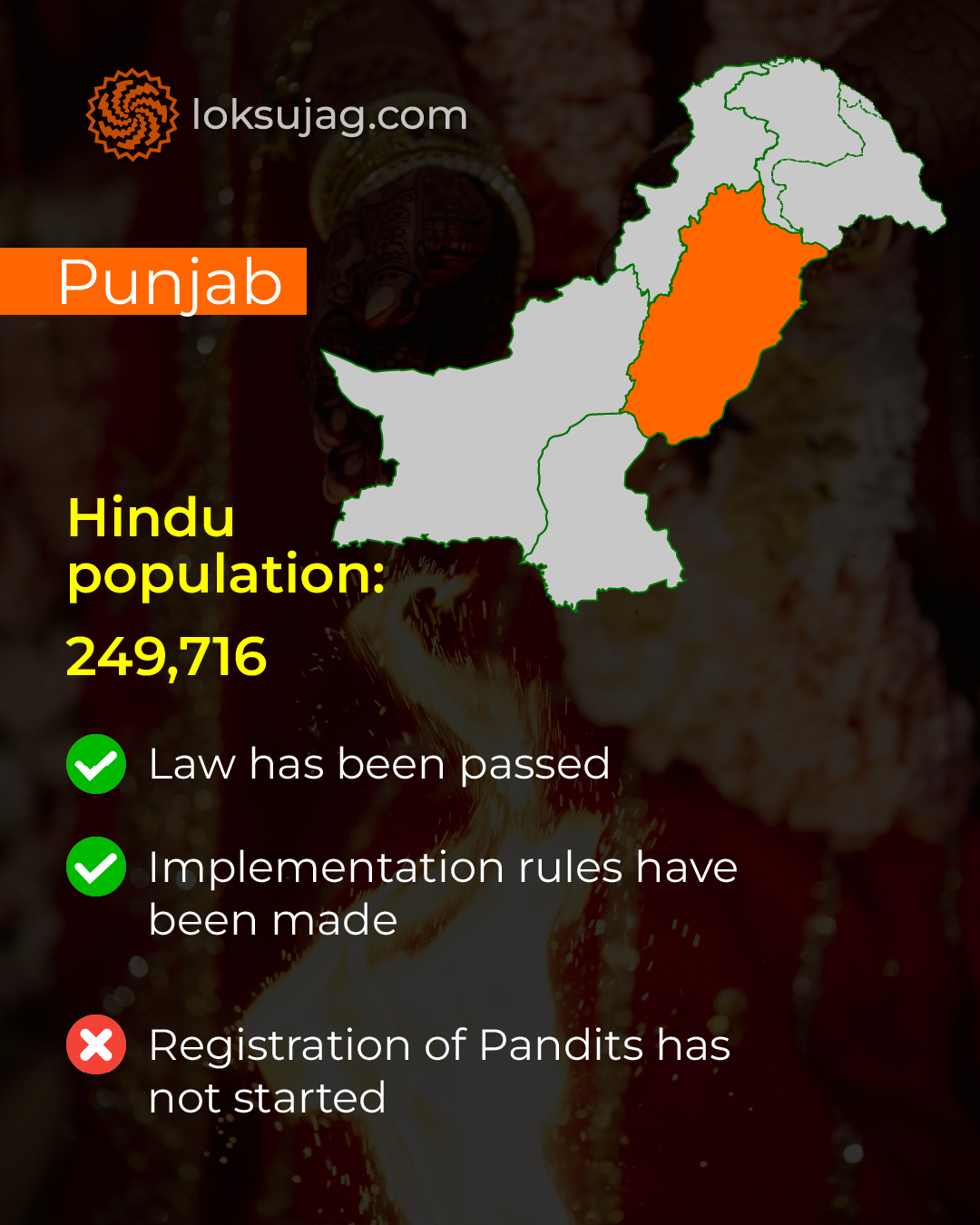
In Punjab, the implementation of this law has begun but the procedure is very complicated. Unlike Sindh, here, the responsibility of registering Pandits lies with the Human Rights and Minority Affairs Department while the registration of marriages is the job of the local bodies.
According to the Punjab Hindu Marriage Rules 2025, the Pandit will apply to the deputy commissioner for his registration who will send it to the Human Rights and Minority Affairs Department after verification. The same department will issue a registration certificate to the Pandit.
The Pandit (Marriage Registrar) will be responsible for issuing and maintaining records of the marriage certificate. He will submit the marriage certificate to the UC concerned from where the NADRA certificate will be issued.
Rahim Yar Khan district of Punjab has the largest Hindu population in the province, consisting of 176,416 people. Pandit Devaji Ram, a resident of this district, says that so far only five Pandits have been registered in the entire district and registration of marriages has not started yet.
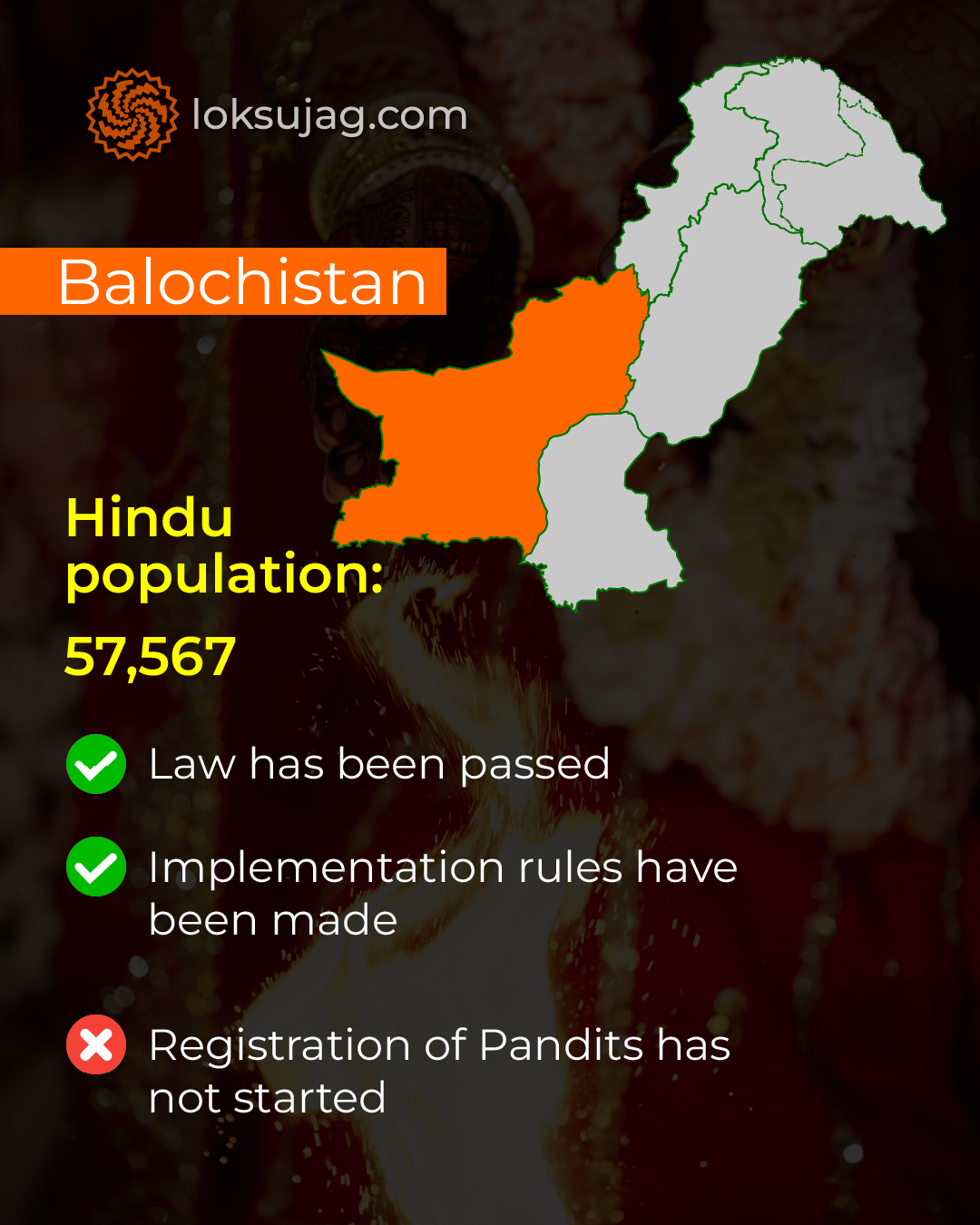
Hindu marriage was implemented in Balochistan six years ago where the Sindh rules have been adopted, but Pandits (marriage registrars) or marriage registration has not started yet in the entire province. However, NLD member Shezan William from Quetta says things have been streamlined. Hopefully, marriage registration will start here soon.
Published on 9 Feb 2026